¶ Notes · August 2026
The same hundred euros, three forms, different protections
A hundred euros in a bank account, in an electronic money wallet, or as an EMT look alike on screen. They give you neither the same claim, nor the same exit routes, nor the same protection. EURXT and EURI show that even among EMTs, the arrangement still decides.
A hundred euros in a bank account. A hundred euros in an electronic money wallet held at an electronic money institution. A hundred euros as a euro stablecoin, legally classified as an e-money token under MiCA.
On screen, all three can display "€100". But the verbs already differ. In an account, you deposit, transfer or withdraw. In a wallet held at an electronic money institution, you hand over funds in exchange for electronic money, then use it to pay or ask for its redemption. With an EMT, you receive tokens at issuance or buy them on a market, then you transfer them, sell them at the market price, or ask the issuer to redeem them at face value.
These journeys are not interface variants. They reveal who owes you the money, what the issuer may do with it, and which path is available to get it back.
A euro balance is not defined by the figure on screen, but by the claim it represents, the place where the funds sit, and the legal regime that organises their return.
Analysis as of 11 August 2026. It offers a product reading grid, not legal advice on an individual situation.
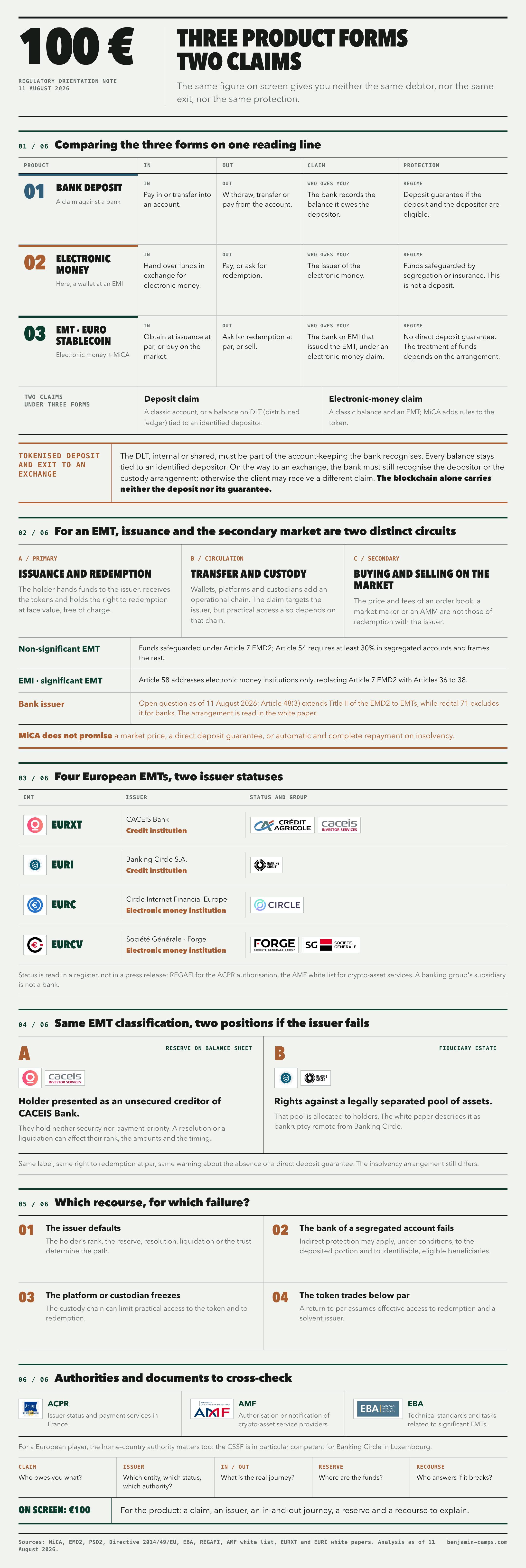
Three product forms on screen
The three balances correspond to three operational journeys.
| Product form | How the €100 come in | What you hold | How the €100 go out |
|---|---|---|---|
| Bank deposit | Deposit or transfer into an account | Deposit claim against the bank | Withdrawal, transfer or payment from the account |
| Classic electronic money | Loading against a handover of funds | Electronic-money claim against the issuer | Payment or redemption of the electronic money |
| EMT under MiCA | Issuance at par with the issuer, or purchase on the secondary market | Electronic-money claim against the issuer, represented by a token | Transfer, sale at the market price, or redemption at par with the issuer |
The third row contains two circuits a product must keep apart. On the primary market, the issuer receives the funds, issues the tokens and handles redemption at face value. On the secondary market, a platform or another mechanism organises buying and selling at a market price, with its own fees and its own custody chain. Buying a hundred euros of tokens on a platform therefore does not necessarily mean receiving a hundred tokens, nor having immediate direct access to redemption.
Two claims under these three forms
The first legal question is not "which blockchain?", it is which claim?
DLT (distributed ledger technology) lets several participants share and synchronise the same record of operations under common validation rules. A blockchain is one possible form of DLT, but a DLT is not necessarily public or open to everyone. In this note, "on DLT" therefore describes the medium and the governance of the ledger; on its own, the expression does not determine the legal nature of the claim (MiCA, Article 3(1)(1) and (2)).
| Underlying claim | Classic representation | Tokenised representation | What tokenisation changes |
|---|---|---|---|
| Bank deposit | Balance recorded on the bank's ledger | Nominative deposit balance held or represented on DLT by the bank | The ledger and the access arrangements; classification depends on the setup |
| Electronic money | Electronic money balance | EMT issued by a bank or an electronic money institution | The medium, to which MiCA adds rules specific to the EMT |
A bank is not legally a "sturdier" electronic money institution: these are two distinct categories of issuer. MiCA allows both a credit institution, that is a bank, and an electronic money institution to issue an EMT. Where the issuer is a bank, the token nonetheless remains an electronic-money claim; it does not become a covered deposit by that fact alone (MiCA, Article 48(1) and (2)).
The bank deposit
The Deposit Guarantee Schemes Directive defines a bank deposit as a credit balance resulting from funds left in an account or from temporary situations deriving from normal banking transactions, which the credit institution must repay under the applicable legal and contractual conditions. It is therefore already a claim against a bank. The account is not a safe holding the client's funds: it is the record that attributes a balance to a depositor and establishes what the bank owes them. The sum deposited creates a debt of the bank towards the client and sits on its liabilities. The bank may use the funds in the course of its business. Depending on the product and its terms, it may remunerate the depositor by paying interest. The deposit may also fall under a deposit guarantee scheme, up to €100,000 per depositor per institution, but only if the deposit and the depositor are eligible. A retail client's current account is in principle covered; a deposit placed by another bank or a financial institution on its own behalf is not. Identification is therefore not enough: the nature of the balance and the category of depositor count too. That reservation matters particularly for institutional offerings (Directive 2014/49/EU, Articles 2(1)(3), 5 and 6).
Electronic money, then the EMT
Electronic money is another claim. The EMD2 defines it as electronically stored monetary value representing a claim against the issuer, issued on receipt of funds for the purpose of payment transactions and accepted by a person other than the issuer. For an electronic money institution (the wallet case compared here), the funds received must be exchanged without delay for electronic money, do not constitute deposits, and must be safeguarded. The EMD2 and the PSD2 then set out two general methods: either segregation of the funds in a separate account or in secure, liquid low-risk assets, or an insurance policy or comparable guarantee taken out outside the group (EMD2, Articles 2(2), 6(3) and 7, PSD2, Article 10).
MiCA defines an e-money token, or EMT, as a crypto-asset that purports to maintain a stable value by referencing the value of one official currency. "Stablecoin" remains a market label, not a single legal classification: a token referencing one official currency falls within the EMT definition, while a token referencing other values, rights or combinations may fall within the asset-referenced token category. The EMT is not a fourth claim: Article 48 of MiCA says it is electronic money (MiCA, Articles 3(1)(6)-(7) and 48(2)).
In this note, issuing an EMT means the primary operation described by Article 49: the issuer receives funds and issues the tokens at par; the holder obtains a claim against that issuer and a right to redemption at par. Buying an already-issued EMT on the secondary market transfers the existing token: that is not, by itself, a new issuance by the issuer. If the funds handed over come from debiting a bank account, the operation replaces the deposit claim with the electronic-money claim by the same amount; it does not "tokenise" the deposit (MiCA, Article 49, EBA report, Annex, Diagram 3).
For the three forms compared here, the right mental map fits in one line: two underlying claims, and a MiCA layer for the EMT.
"Tokenised deposit": an expression to check
"Tokenised deposit" is not a standalone legal category created by MiCA. The European Banking Authority uses the expression in a narrow sense: a claim that already meets the definition of a deposit is recorded on a DLT. The DLT then forms part of the account-keeping arrangement recognised by the bank. It may be internal to the bank, operated by a third party or shared with other institutions: what matters is not where it is hosted, but the governance of entries and their recognition by the bank as deposit balances. Two architectures are possible. In a one-ledger model, the DLT replaces the traditional bank ledger and becomes the primary record: the bank ties to an identified client the balance it owes them, along with every debit and every credit. In a two-ledger model, the client holds deposit claims on the traditional ledger and on the DLT; the bank reconciles the two, and the total deposit is the sum of both balances. A DLT address may then replace the IBAN as the technical identifier, and a wallet may be no more than the access and signing interface. Tokenisation therefore does not, by itself, change the nature or the classification of the deposit (EBA, Report on Tokenised Deposits, introductory definition, points 3 and 24 to 26 and Annex, BIS, unified-ledger architecture and permissioned governance).
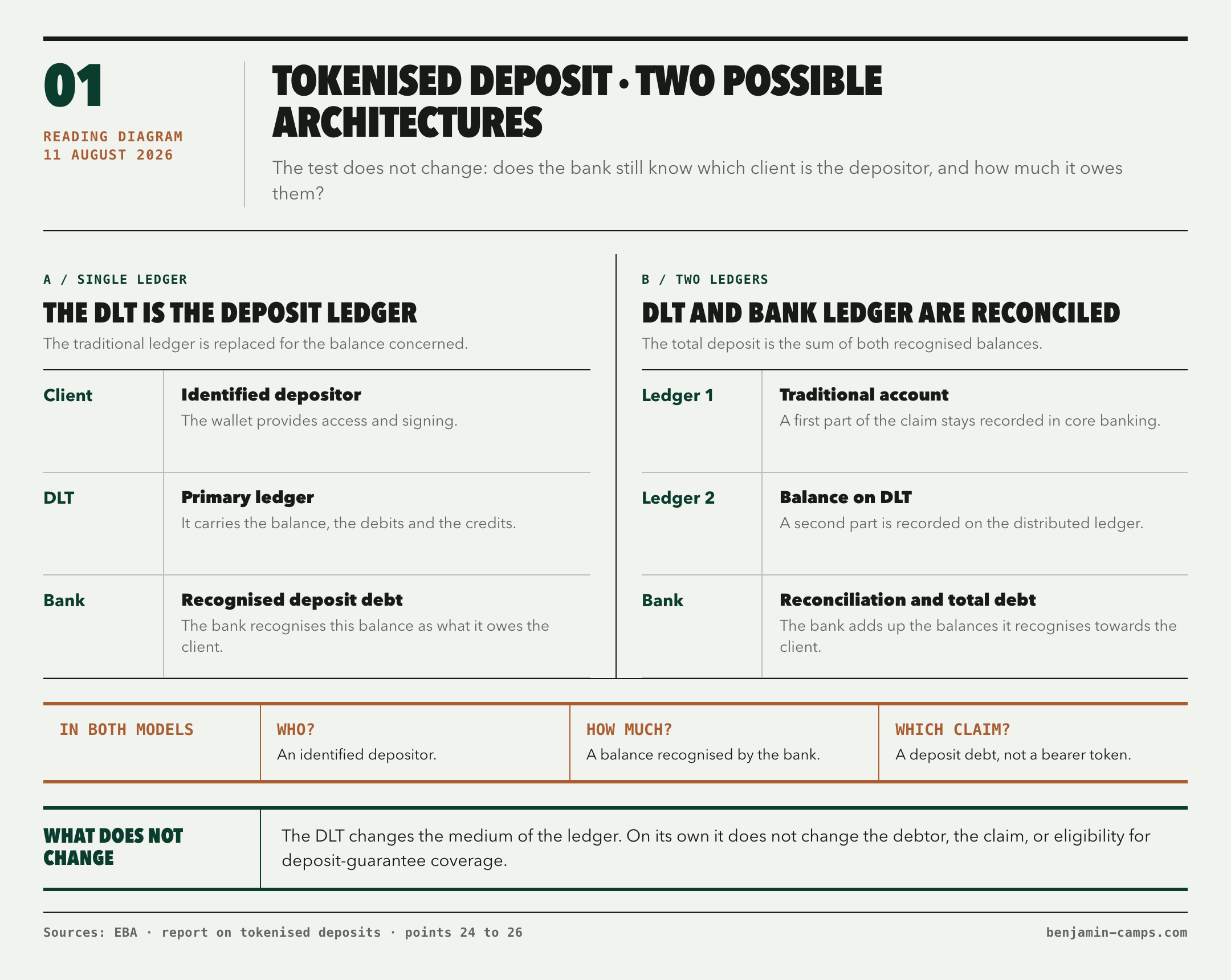
In other words, "continuing to record the claim" means that after every operation, the bank's deposit record (the DLT alone, or the reconciled combination of both ledgers) still states which identified client is the depositor and how much the bank owes them as a deposit. The bank maintains that continuous contractual relationship; the claim is not a bearer instrument freely transferable to someone who is not a client. A payment debits or extinguishes the payer's deposit claim and credits or creates the recipient's: it is not the same claim travelling from wallet to wallet (EBA report, point 26 and Table 2).
In that nominative model, deposit-guarantee coverage applies under the same conditions as for a classic deposit. It attaches neither to the token nor to the wallet: the deposit and the depositor must be eligible, the depositor must be identifiable, and all their covered deposits at the same bank are aggregated within the €100,000 ceiling (EBA report, Table 2, Directive 2014/49/EU, Article 6).
But the expression can conceal a different arrangement. If a deposit account is debited against the issuance of a token classified as an EMT, the deposit shrinks or disappears by the same amount. The holder then acquires an electronic-money claim against the issuer, not a tokenised representation of their former deposit. The funds received may be held or invested by the issuer under the rules applicable to its status and to the arrangement: they may in particular be placed with a bank, but that does not give the EMT holder a direct deposit claim against that bank. An EMT can therefore be backed by deposits without itself being a tokenised deposit (EBA report, Annex, Diagram 3).
If a token presented as a tokenised deposit is transferable to a bearer without the bank necessarily knowing its new holder, the EBA considers that its legal viability and its classification must be assessed case by case. Calling every token issued by a bank a "tokenised deposit" therefore becomes a misuse of the term (EBA report, point 26).
Technical vocabulary settles nothing on its own. The deciding questions are: which claim does the holder own and against which debtor, who is the identified depositor, was the account kept or debited, and can the claim circulate without the bank changing its nominative record?
Sending it to an external exchange: who then holds which claim?
A CEX (centralised exchange) is a platform run by an entity that organises trading and may, depending on its services, hold its clients' assets in custody.
Going through a blockchain, even a public one, does not automatically carry the deposit classification or its guarantee. In the nominative model observed by the EBA, an external address can receive the balance as a deposit only if the bank's arrangement accepts the operation and still allows it to identify the depositor. If the bank does not know the new holder, the instrument leaves that account-based model; the legal viability and classification of any bearer-like token must then be assessed case by case (EBA report, point 26).
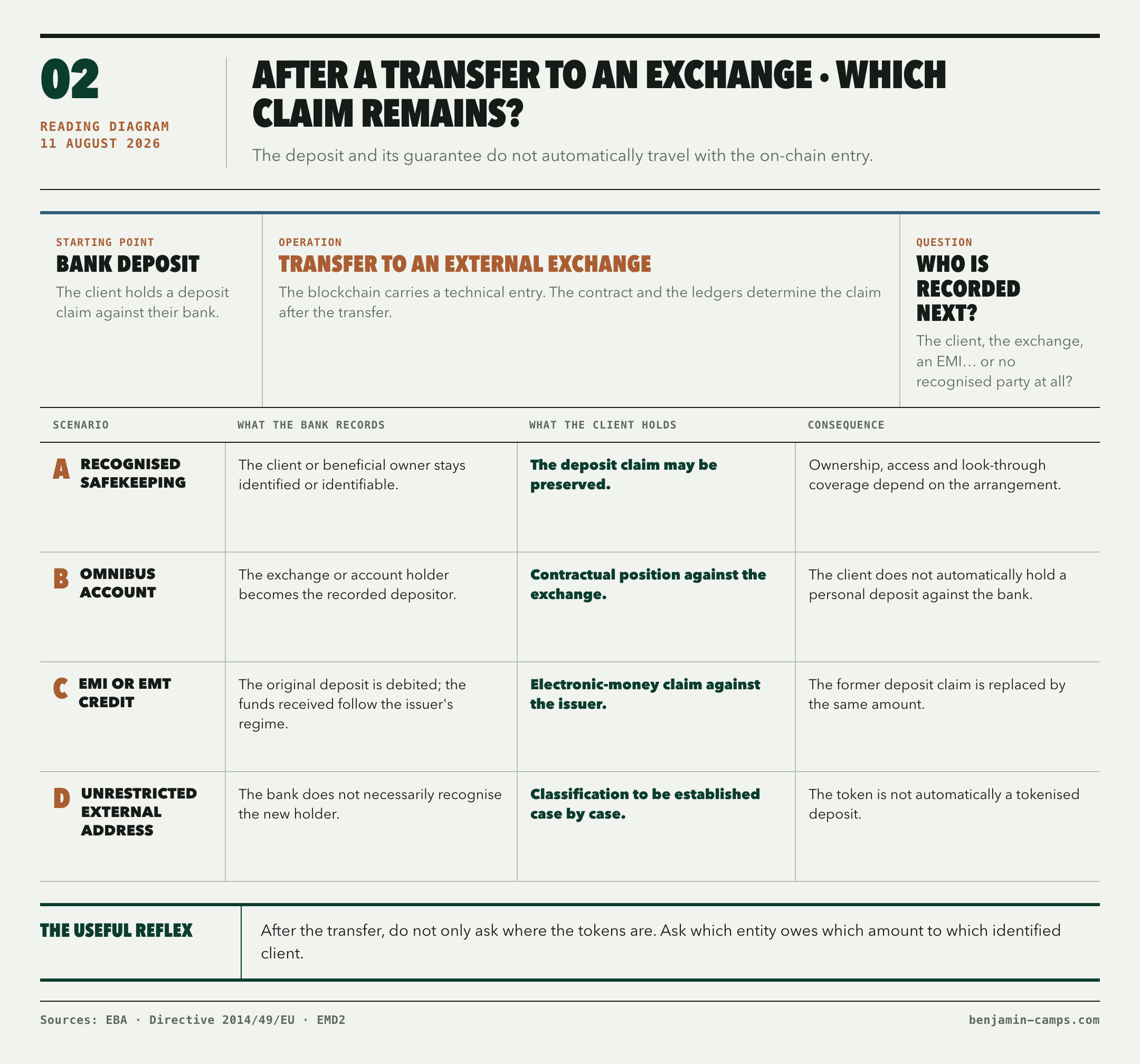
Three checks remain decisive in the arrangement: does the beneficial owner remain identifiable, who stays recorded as the depositor, and which entity receives the value, under which service, and then becomes directly indebted to the client?
The Deposit Guarantee Schemes Directive allows, in certain intermediated structures, the person absolutely entitled to be covered if they were identified or are identifiable before the failure. That look-through mechanism is however neither automatic nor attached to the wallet (Directive 2014/49/EU, Article 7(3)). The fact that a group operating an exchange also holds an electronic money institution authorisation is therefore not enough. The EMD2 prohibits an electronic money institution from receiving those funds as deposits, and requires funds received in exchange for electronic money to be safeguarded (EMD2, Articles 6(2) and (3), and 7).
A genuine tokenised deposit is also outside MiCA's scope. A CASP authorisation and the MiCA custody rules are therefore not sufficient, on their own, to turn its receipt by an exchange into a bank deposit. Conversely, if the asset received is an EMT, it remains an electronic-money claim against its issuer, and its custody by a CASP is governed in particular by Article 75 of MiCA (MiCA, Articles 2(4)(b) and 75).
What MiCA requires for an EMT, and what that does not guarantee
The rules below apply exclusively to EMTs, including where they are issued by a bank. They do not apply to a tokenised deposit in the strict sense, which remains a deposit and may fall under deposit-guarantee coverage if the deposit and the depositor are eligible.
MiCA imposes several obligations and grants the holder of an EMT several precise rights:
- to offer an EMT to the public or seek its admission to trading in the Union, the issuer must be a credit institution or an electronic money institution, notify a white paper to the competent authority and publish it (Article 48);
- the holder has a claim against the issuer and may request redemption at face value, at any time and free of charge (Article 49);
- neither the issuer nor the crypto-asset service provider may grant interest or any benefit linked to the length of holding (Article 50);
- the white paper must carry on its first page the statement that it has not been approved by any competent authority, and a clear warning that the EMT is covered neither by investor compensation schemes nor by deposit guarantee schemes (Article 51(3) and (4));
- funds received and safeguarded in accordance with Article 7(1) of the EMD2 fall under Article 54: at least 30% must remain in segregated accounts at credit institutions; the remainder is invested in secure, low-risk and highly liquid instruments denominated in the same currency. The exact scope of that rule is contested, and the next section sets it out rather than settling it;
- the issuer of the EMT must draw up and notify a recovery plan and a redemption plan within six months of the offer to the public or the admission to trading (Article 55).
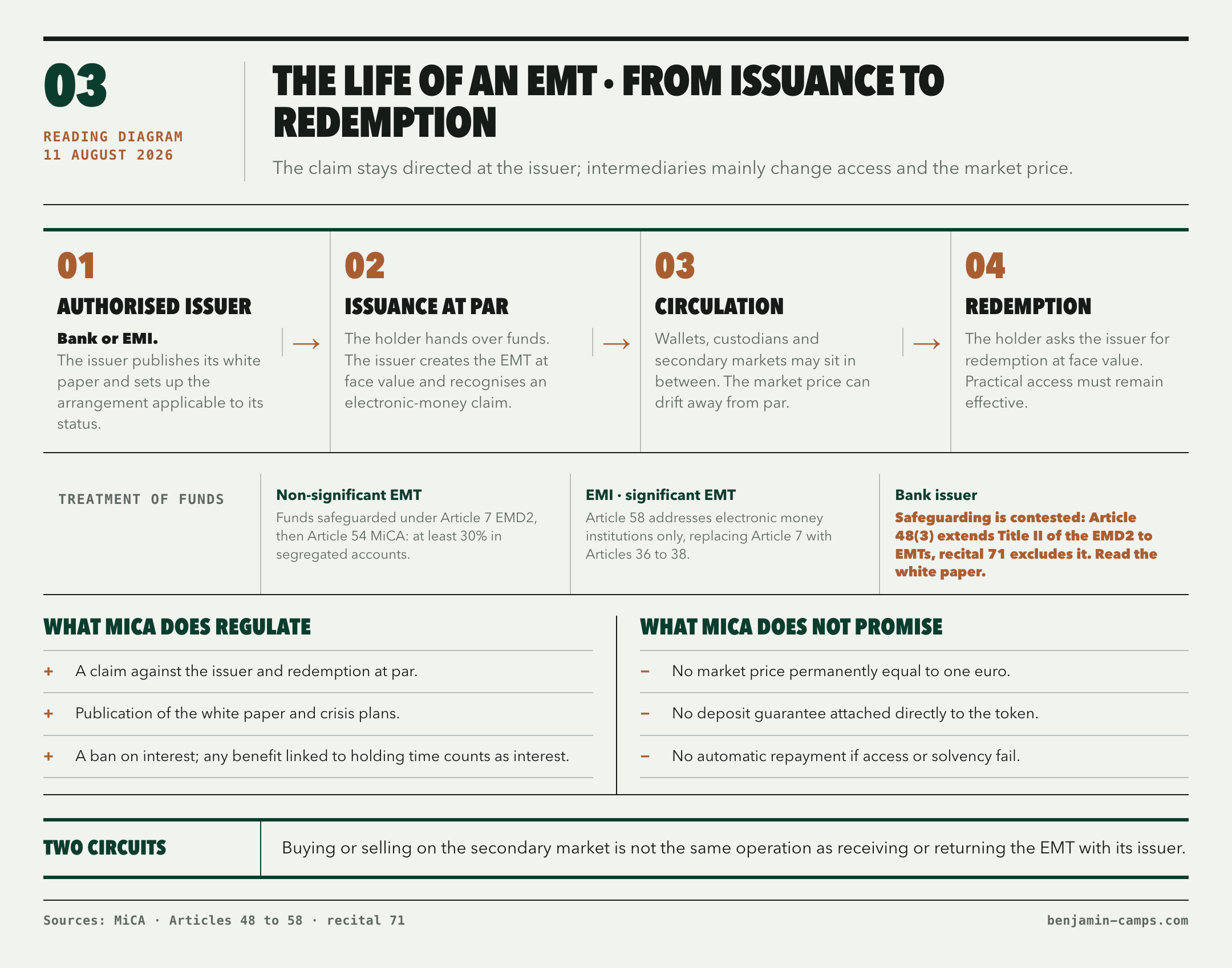
Article 51 requires the white paper to state that the EMT is not covered by deposit guarantee schemes, without nuance or reservation. The reading taken here is that this warning bears on the token itself, and not on the fate of a separate bank account holding part of the funds received. On that reading, it does not exclude a deposit guarantee scheme protecting indirectly, under national law and subject to conditions, certain client funds placed in such an account. In France, that look-through protection may in particular depend on the identification and eligibility of the persons entitled. It then attaches to the deposit held with the failing bank, not to the token; it therefore promises the holder no automatic and complete repayment of their EMT if the issuer fails. This is a reading, not a position of authority: nothing in Article 51 states it (ABE Infoservice, Directive 2014/49/EU, Article 7(3)).
Safeguarding for a bank-issued EMT: an open question
For a significant EMT issued by an electronic money institution, Article 58 substitutes in particular the reserve requirements of Articles 36 to 38 for Article 7 of the EMD2, and adds reinforced own-funds and liquidity requirements. The competent authority may also impose all or part of those requirements on a non-significant EMT. On this point the text is clear, and it is clear in both directions: Article 58 expressly addresses "electronic money institutions", and them alone.
That leaves the most contested question, and it is better posed than settled. Must a bank issuing an EMT safeguard the funds received under Article 7 of the EMD2, and therefore apply the Article 54 split? Two readings compete, each grounded in the text.
| Reading | What supports it | What it implies |
|---|---|---|
| Safeguarding applies | Article 48(3) provides that "Titles II and III of Directive 2009/110/EC shall apply with respect to e-money tokens unless otherwise stated in this Title". Article 7 of the EMD2 sits in its Title II. Article 54, for its part, addresses "issuers of e-money tokens", with no condition of status, where Article 58 expressly writes "electronic money institutions". | A bank issuer safeguards, and the 30% floor is enforceable against it. |
| Safeguarding does not apply | Recital 71 states that those provisions "do not apply to credit institutions when issuing e-money". Article 1(2) of the EMD2 also reserves its Title II to electronic money institutions. | The bank falls under its banking prudential regime alone, and Article 54 does not target it. |
A recital illuminates the legislator's intent; it does not carry the binding force of an article. Here Article 48(3) says the opposite of recital 71, and no provision of Title IV expressly rules out safeguarding for a non-significant EMT issued by a bank. As of 11 August 2026, the question remains open, and a product note has no business closing it.
Fortunately, the practical consequence does not depend on the outcome. The "30% in separate accounts, 70% in eligible assets" formula transfers neither automatically to a bank, nor without checking the regime of a significant EMT. What is enforceable for the holder is the arrangement the issuer describes in its white paper, not the rule one assumes applies to it (MiCA, Articles 48(3), 54, 56 and 58, and recital 71, EMD2, Articles 1(2) and 7).
Recovery and redemption plans are, for their part, instruments of crisis preparation and management. They are neither deposit insurance nor a promise of automatic and complete repayment. Nor do these obligations amount to a market-price guarantee: the right to redemption is enforceable against the issuer, but exercising it still depends on access to redemption, on the legal structure of the funds received, and on the issuer's situation.
EURXT and EURI: same classification, opposite arrangements
This is where the comparison becomes useful to a product.
At the launch of EURXT, Crédit Agricole announced a reserve made up exclusively of cash and held on the balance sheet of CACEIS Bank (official press release). That dated snapshot of the reserve must not be confused with its possible composition: the white paper provides that part of it may be invested in the instruments MiCA authorises. Above all, it states that EURXT holders are unsecured creditors of CACEIS Bank. An unsecured creditor holds neither a specific security, such as a pledge or a charge, nor a priority giving them precedence over certain assets. In a resolution or a liquidation, they are repaid according to their rank, after better-ranked creditors and within the limit of available assets; amounts and timing can therefore be affected (EURXT white paper).
For EURI, Banking Circle describes on the contrary a reserve placed in a separate fiduciary estate. This is a pool of assets legally separated from the bank's own estate and allocated to the rights of EURI holders. The holder therefore exercises their rights against that dedicated pool, and not as an ordinary creditor of the whole of Banking Circle's estate. The white paper presents the arrangement as bankruptcy remote from the issuer's insolvency. That legal separation is however not a deposit guarantee: recourse depends on the fiduciary arrangement and on the law applicable to it (EURI white paper).
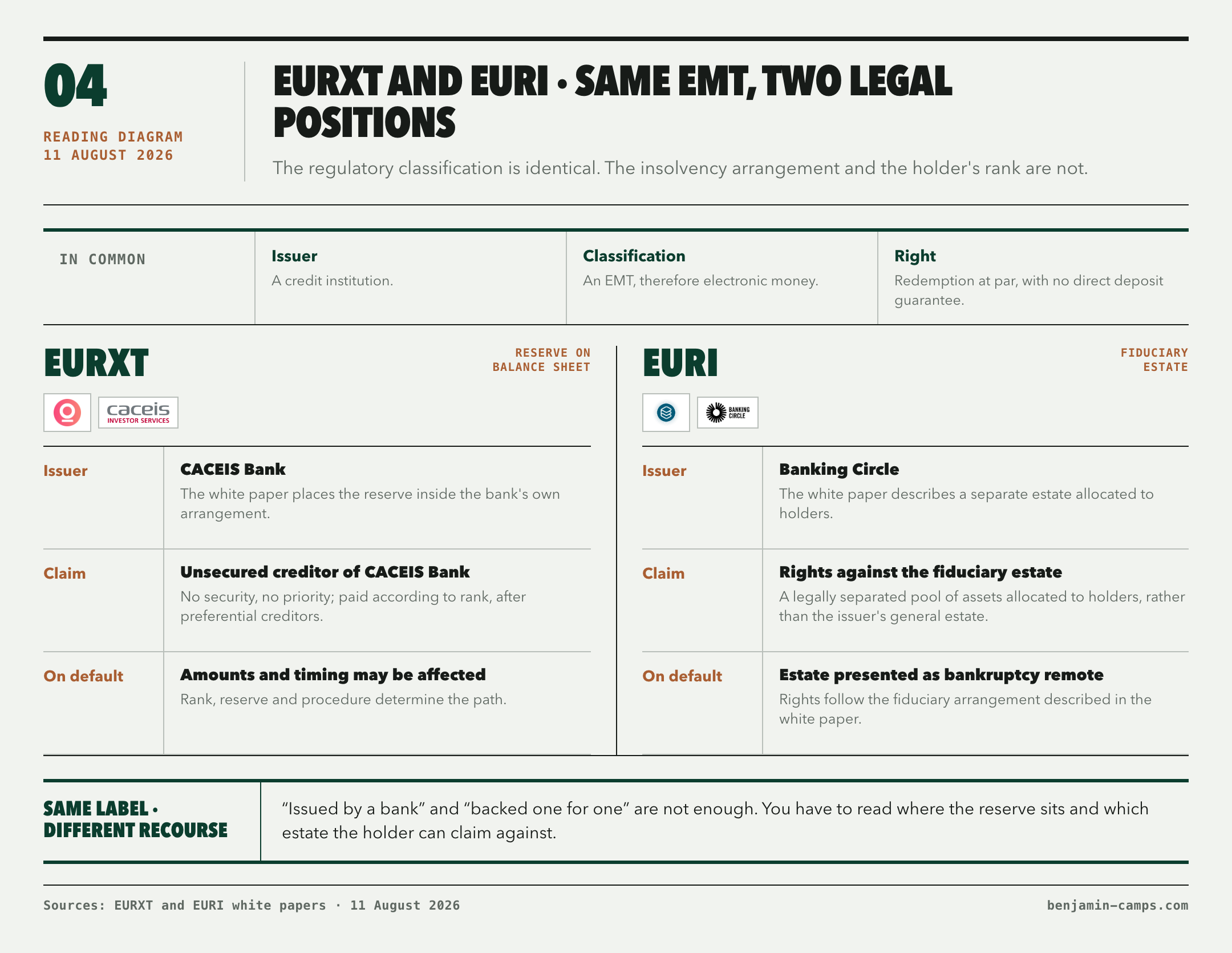
In both cases:
- the issuer is a credit institution;
- the token is an EMT, therefore electronic money;
- the white paper carries the warning of no direct deposit guarantee;
- the holder has the right to redemption provided by MiCA.
But the path followed if the issuer fails is not the same. That is precisely why the phrases "issued by a bank", "segregated reserve" or "backed one for one" are not enough.
Issuer status, for its part, is read in a register and not in a press release. The four main euro tokens on the European market split across two statuses. EURXT is issued by CACEIS Bank and EURI by Banking Circle S.A., two credit institutions. EURC is issued by Circle Internet Financial Europe, authorised as an electronic money institution by the ACPR on 1 July 2024, and EURCV by Société Générale-Forge, authorised under the same status in July 2024 (REGAFI, the ACPR register of financial agents, AMF, white list of crypto-asset service providers, SG-Forge). A banking group's subsidiary is not a bank: what governs is the status of the issuing entity, not the name of the group.
Which recourse, for which failure?
There is no single protection attached to the word "EMT". The event has to be isolated.
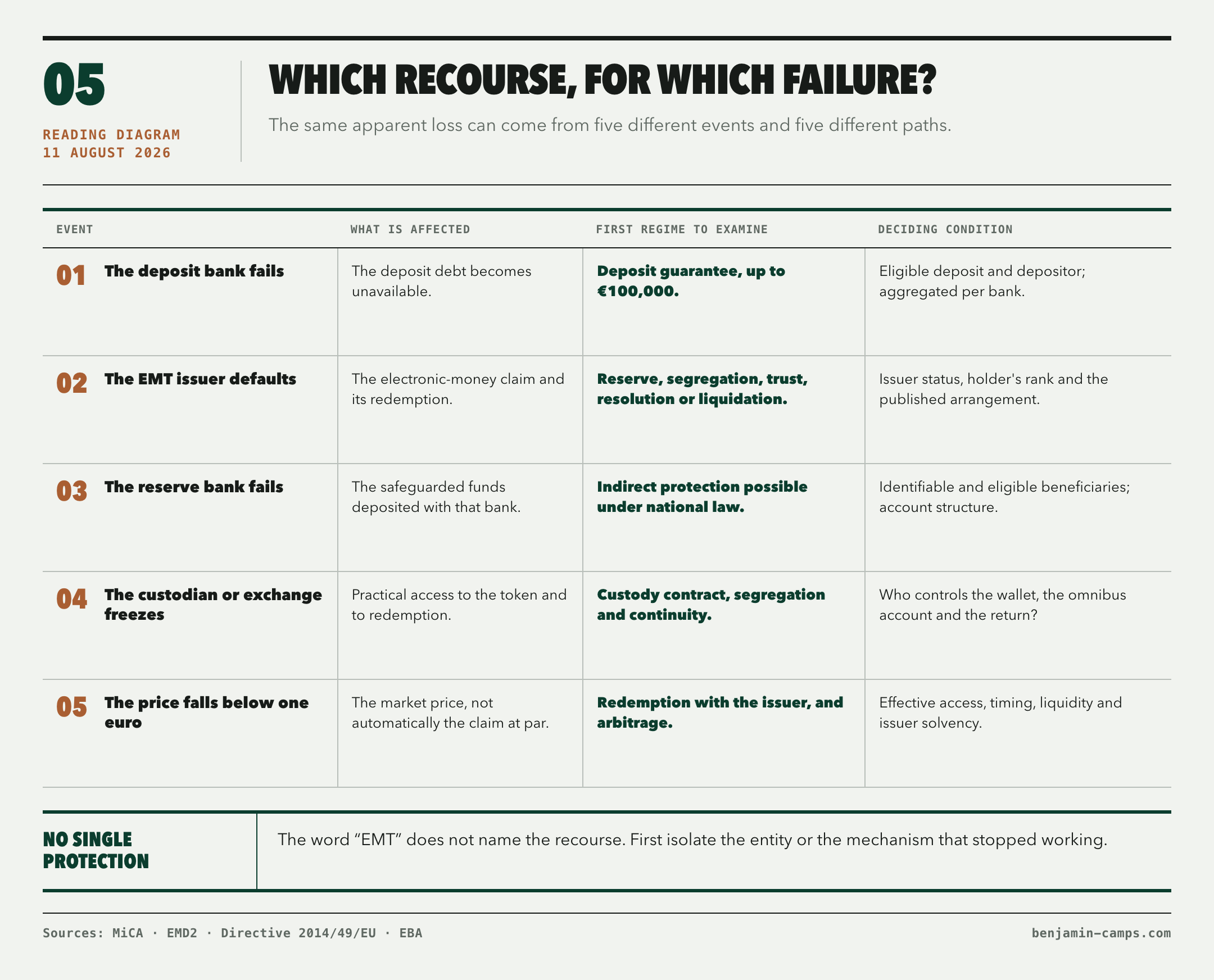
The bank holding a deposit fails
The deposit guarantee scheme may compensate up to €100,000 per depositor per institution, subject to its eligibility conditions. The ceiling aggregates the covered deposits of the same depositor at the same bank.
For a tokenised deposit in the strict sense, using a DLT does not change that ceiling. The bank must nonetheless be able to identify the depositor and mark the balance as an eligible deposit. A wallet therefore does not carry a standalone €100,000 guarantee.
The electronic money or EMT issuer defaults
There is no guarantee fund dedicated to the token. The outcome depends on the mechanism actually adopted, on the applicable law and on the holder's rank. A segregated pot, an insurance policy, a fiduciary estate and a reserve kept on the issuer's balance sheet do not open the same path. One cannot therefore write, as a general rule, that "the liquidator returns the pot".
The bank holding a separate account fails
In France, an indirect protection from the deposit guarantee scheme may step in, in certain cases, for the portion actually deposited, if the persons entitled are identifiable and eligible. The other deposits of the same person at the same bank count towards the ceiling. That French solution must not be presented as a uniform European rule; the EBA has observed national discrepancies in the protection of client funds (ABE Infoservice, EBA finding).
A platform or a custodian becomes unavailable
The claim provided by MiCA remains directed at the issuer, but practical access to the token and to redemption may depend on the custody chain, on an omnibus account and on the provider's terms. Saying the platform "is only an intermediary" therefore hides a real product risk.
The token trades below one euro
The secondary market guarantees no price. Depending on the trading venue, the price may come from an order book, a market maker, an automated mechanism or an over-the-counter trade. The right to redemption at face value exists with the issuer; arbitrage only works if that access stays effective and if the market believes the issuer can honour its debt.
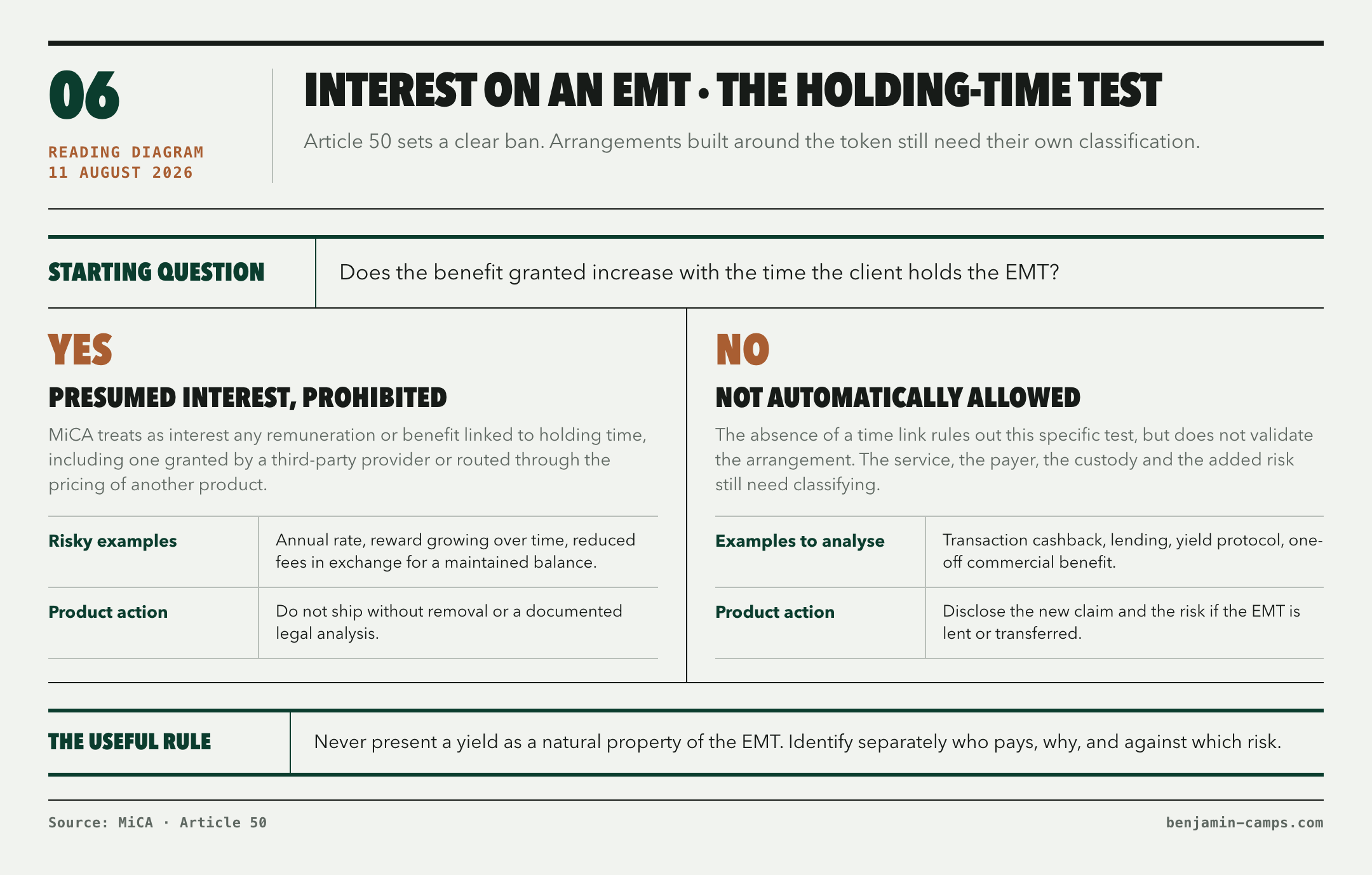
Interest: a clear rule, arrangements to examine
Article 50 prohibits the issuer and the crypto-asset service provider from granting interest on an EMT. It also treats as interest any benefit linked to the length of holding, including where it runs through the pricing of other products.
That does not allow one to conclude that all cashback is permitted, that interest would automatically reclassify the EMT as a deposit, or that any yield product would make the claim against the issuer disappear. Those conclusions depend on the contractual arrangement, on the custody of the tokens and on the added risk. The product rule is simpler: any remuneration around an EMT must be analysed separately, and the risk of the added layer must be displayed.
The product decision grid
For a product leader, choosing a euro token is not a simple technical integration choice. Before choosing the token, the provider or the words shown on screen, five questions must be documented.
| Step | Question to settle | Evidence to keep |
|---|---|---|
| 1 · Claim | Deposit, electronic money, EMT, or an additional claim against a lender or a protocol? For a "tokenised deposit", does the bank keep a nominative relationship with the depositor? | Contract, product terms, ledger recognised by the bank, and legal classification |
| 2 · Issuer | Which legal entity issues or receives the value, under which status and which authority? In France, distributing and holding an EMT may also fall under payment services (ACPR). | Authorisation registers, white paper, and entity org chart |
| 3 · Reserve | Where do the funds sit and what is their legal status? | Composition, custodian, segregation or trust, holder's rank, and attestations |
| 4 · Redemption | How does the user actually exercise their right to redemption? | Direct or intermediated journey, thresholds, timing, controls, and fees outside redemption itself |
| 5 · Failures | What happens if the issuer, the reserve bank, the custodian, the platform or the market fails? | Crisis plans, custody contracts, liquidation rules, and incident procedure |
The white paper is an indispensable piece of that analysis, not its sole arbiter. It is drawn up under the issuer's responsibility and is not approved by the authority. It must be cross-checked against authorisation registers, the provider's terms, the custody and redemption arrangements, and the publications on the reserve.
This analysis directly governs the product: protection regime, redemption journey, remuneration, choice of custodian, incident management, and the wording displayed. Writing "your funds are guaranteed" next to an EMT balance is false. Writing "backed one for one" without stating the nature and location of the reserve is incomplete.
On screen, the product shows a hundred euros. Its responsibility is to explain the claim, the reserve and the recourse that sit behind it.
Sources
The primary sources cited in the note.
- Regulation (EU) 2023/1114, MiCA
- Directive 2009/110/EC, the EMD2
- Directive (EU) 2015/2366, the PSD2
- Directive 2014/49/EU on deposit guarantee schemes
- EURXT white paper, CACEIS Bank, 3 April 2026
- Crédit Agricole launches EURXT through CACEIS, 1 July 2026
- EURI white paper, Banking Circle
- EBA, Report on Tokenised Deposits, December 2024
- ABE Infoservice, protection of client funds at payment and electronic money institutions
- EBA, national discrepancies in the protection of client funds
- ACPR, payment services associated with EMTs
- REGAFI, the ACPR register of financial agents
- AMF, white list of crypto-asset service providers
- BIS, Annual Economic Report 2025, the unified ledger